Request I-20 or DS-2019

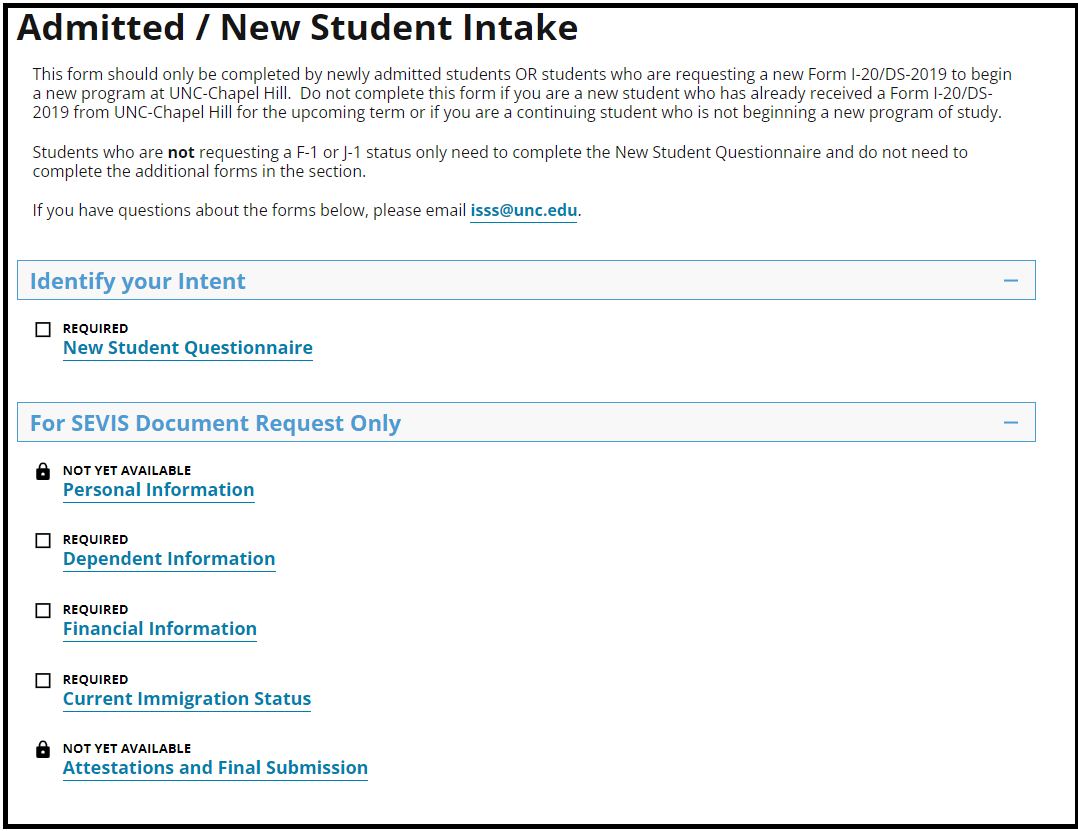
Students requesting F-1 or J-1 sponsorship from UNC Chapel Hill, must complete and submit all of the e-forms under Request a Form I-20/DS-2019 in the Admitted/New Student Checklist, including:

  • Personal Information
  • Current Immigration Status
  • Dependent Information
  • Financial Information

Once all forms have been submitted, students will receive an email confirmation.

Processing of the Form I-20 or Form DS-2019 takes approximately three weeks from the date all forms (as listed above) have been submitted. Once the Form I-20 or DS-2019 has been issued, it will be sent to the student as a PDF file via email. These documents will be sent to the student’s preferred email address as listed in their Student Center in ConnectCarolina because that will be the address indicated in SEVIS.  Students will need to make sure they are checking their UNC email address for this form along with any other updates from ISSS.

Students should contact the ISSS office for assistance at isss@unc.edu, if needed.

Upon receiving the Form I-20 or Form DS-2019, students should print out the form and sign in ink at the bottom of page 1 in order to use the documents for the visa appointment and entry into the U.S.

NOTE: Students who have been admitted to UNC for the fall semester should upload all documents to the ISSS Portal by July 1st.  For the spring semester, students should upload all required documents by November 1st.

Cost Estimates

International students requesting F-1 or J-1 visa sponsorship from the UNC-Chapel Hill must provide evidence of sufficient funds to cover tuition, fees, living expenses, and health insurance to be issued a Form I-20 or Form DS-2019.  For estimated costs of attendance for your program, please see below:

Financial Requirements

Students may show funding from multiple sources and may submit as many documents as necessary to document adequate funds from all sources of support.

Important to note: Bank documents may show funds in any currency (USD not required) as long as the currency used is clearly indicated on the document. Financial statements from family members or other personal sponsors must be accompanied by the Affidavit of Financial Support form.

Students must submit electronic copies of official financial documents.  Screenshots and unofficial electronic printouts are not valid for the purpose of Form I-20 or Form DS-2019 issuance.  Financial documents must meet all of the requirements listed below:

  • Be an official bank document (signed and stamped, or an official monthly electronic statement)
  • Be written in English
  • Contain an issuance date within the last 6 months
  • List the account holder’s full name
  • List the account type
  • Indicate the current balance and currency
  • All funds must be liquid and immediately available for withdrawal (most commonly: checking, savings, or current accounts)
  • All documents must be uploaded in PDF, JPEG, or PNG format. Microsoft word documents are not an acceptable document type.

Below are acceptable funding sources and the corresponding documents required:

Funding Source Documents Required
Personal Funds
  1. Copy of an official bank certification with student’s name listed as the account holder
Parents or Other Personal Sponsors
  1. Completed Affidavit of Financial Support
  2. Copy of an original bank certification in the sponsor’s name
University Funding
  1. Copy of your award letter with details of your scholarship.  The letter must be on university letterhead and must be signed; copies of email correspondence will not be accepted as proof of the award.
External Scholarship(s)
  1. Copy of award letter, scholarship letter, or other certification of sponsorship with English translation (if applicable) from an authorized person to certify accuracy.
Education Loan(s)
  1. Loan approval/loan sanction letter confirming the loan amount approved and the date(s) the funds will be distributed to the recipient.

SEVIS Transfer

Students currently studying in F-1 or J-1 status at an SEVP-Approved School in the U.S., or currently in a valid period of post-completion OPT, may transfer their SEVIS record to UNC-Chapel Hill.

F-1 Transfer Student Eligibility and Timeline

Students must be in valid F-1 status to be eligible for the transfer of their SEVIS record.  Additionally, students must begin study at UNC-Chapel Hill within the following timeframe:

  • Student Currently Enrolled at Another SEVP-Approved School: Students must begin study at UNC-CH at the next available term, or within 5 months of their last date of enrollment at their previous institution, whichever is sooner.
  • Student Currently in a Period of Approved Post-Completion OPT: Students must begin study at UNC-CH at the next available term, or within 5 months of their last date of OPT authorization, whichever is sooner.  Students whose SEVIS record is released to UNC-CH before the end date listed on their EAD forfeit any remaining time of OPT and must begin study at the next available term, or within 5 months of their SEVIS transfer release date, whichever is sooner.

Students currently in their 60-day grace period may still be eligible for a SEVIS transfer, but should check with their current institution to confirm.

Students should not be transferred to UNC-Chapel Hill in a terminated status.

Requesting a Form I-20/DS-2019 from UNC-Chapel Hill

Students should follow the steps outlined below to request a transfer pending Form I-20/DS-2019:

  1. Work with their current institution to arrange the transfer of their SEVIS record.
  2. Submit all required e-forms in the Request a Form I-20/DS-2019 section of the Admitted/New Student Checklist. The Form I-20/DS-2019 will be created after submission of all required forms and only AFTER the transfer release date in SEVIS.

Visa Stamp

Students transferring their SEVIS record to UNC-CH are not required to obtain a new student visa unless they will be traveling outside the U.S. and their current visa is expired.  If the student’s current visa is still valid, he or she may continue to use the visa along with the UNC-CH Form I-20 or Form DS-2019. Students with expired visas not traveling outside the U.S. may remain in the U.S. and continue to maintain F-1 or J-1 status as long as they properly complete all SEVIS transfer procedures as noted in this section.

F-1 Transfer Employment

On the SEVIS release date, the student no longer has work authorization on or off-campus from the previous school. This includes any periods of Curricular Practical Training (CPT) or Optional Practical Training (OPT). Because authorization for CPT or OPT ends on the transfer release date, students should consider carefully the dates on which they plan to discontinue work and initiate the transfer.Before the student is allowed to begin any employment on-campus at UNC-CH, the student must complete ISSS Student Check-In and must receive a SEVIS Registration Confirmation email from ISSS along with a new Form I-20 showing the transfer is completed.

J-1 Student Transfers

An exchange visitor may transfer from another program sponsor to UNC-Chapel Hill sponsorship, if the purpose of the transfer is to complete the original program objective and if the exchange visitor is currently residing in the U.S. in the J-1 student category. All students should first discuss the possibility of transfer with their sponsoring organization prior to requesting a transfer.

The effective date of the transfer from the current program sponsor to UNC-CH should be discussed with both the Responsible Officer of the current program and ISSS at UNC-CH.  On the effective date of transfer, the student’s SEVIS record will become the responsibility of UNC-CH.

Change of Status

Admitted students currently in the United States in an immigration status other than F-1 or J-1 who wish to change to F-1 or J-1 status should indicate their intent to request a Form I-20 or DS-2019 on the New Student Questionnaire and proceed to complete and submit all of the e-forms under Request a Form I-20/DS-2019 in the Admitted/New Student Checklist.

Change Status by travelling outside the U.S.

A student may choose to depart the United States, apply for a student visa at a U.S. embassy or consulate abroad and re-enter the U.S. in F-1 or J-1 status. This will require a Form I-20 for F-1 status or Form DS-2019 for J-1 status from UNC-Chapel Hill. To apply for an F-1 or J-1 visa please follow the instructions on the U.S. Department of State Web site and be aware of the visa wait times at the embassy/consulate where you plan to apply.

Some students are not eligible for a change of status within the U.S. and therefore are required to travel outside the U.S. to apply for a student visa. Individuals currently in a visitor visa status (WB, WT, B-1 or B-2), or subject to the two-year home residence requirement based on a stay in J-1 status may not be eligible to change their status in the U.S.  Individuals who have obtained a B-2 visitor visa which indicates “prospective student” or “prospective exchange visitor” may be eligible for change of status within the U.S. and should consult with an immigration attorney.  If you have questions about your eligibility to apply for a change of status within the U.S., please seek qualified immigration advice.

Change of status within the U.S.

Approval for change of status within the U.S. from one non-immigrant category to another is processed through the United States Citizenship and Immigration Services (USCIS).  Students who choose this option will NOT depart the U.S. Instead, they submit a Form I-539 to USCIS to request a change of immigration status within the U.S. We recommend students check the current processing times in order to appropriately time the submission of their change of status application and avoid possible delay in studies and/or employment.

There may be restrictions on continuing to study or work in your current immigration status until the change of status application is approved by USCIS. Students should consult an immigration attorney to discuss these restrictions.